Game Room Cost Planning
A cost-driver guide to game-room furnishing scope for vacation rentals — equipment tiers, finish-out level, room type, and how cost varies across arcade-only, theater-game-hybrid, and multi-purpose entertainment rooms.
Sound familiar?
Owners scoping game-room furnishing usually receive proposals that lump equipment, furniture, finish-out, and lighting into a single total — with no visibility into which drivers move the planning range up or down. The result is comparison-shopping that ranks proposals by total price rather than by the equipment-tier and finish-out level behind the price. Equipment-tier alone can move the planning range 3–4x within the same package level.
In short
- Game-room cost splits into conversion scope and furnishing scope. The conversion cost planning guide covers the first; this post covers the second.
- Equipment tier is the largest furnishing-cost driver — entry-tier through flagship-tier spans a 4–5x range within the same package level.
- Room type (arcade-only, theater-game-hybrid, multi-purpose entertainment) changes the cost-driver mix more than bedroom count does.
- Finish-out level moves cost within any equipment-tier scope. Standard, premium, and flagship finish-out can move the planning range substantially without changing the equipment selection.
- Photo-readiness scope is a real line item. Rooms without scaled photo-prop staging photograph as utility rooms with equipment rather than as destination amenities.
This is a cost-driver decomposition for game-room furnishing scope, not a conversion-process guide and not a quote. The game room conversion cost planning guide covers the construction-adjacent scope (flooring, electrical, HVAC, sometimes garage conversion structural work) and how it interacts with the furnishing layer. This post focuses on what drives the furnishing cost itself — equipment selection, room-type variations, finish-out level, and how the same room scope can sit at very different points in the planning range. Final pricing requires a scoped proposal.
What to know
Conversion cost vs furnishing cost are separate buckets
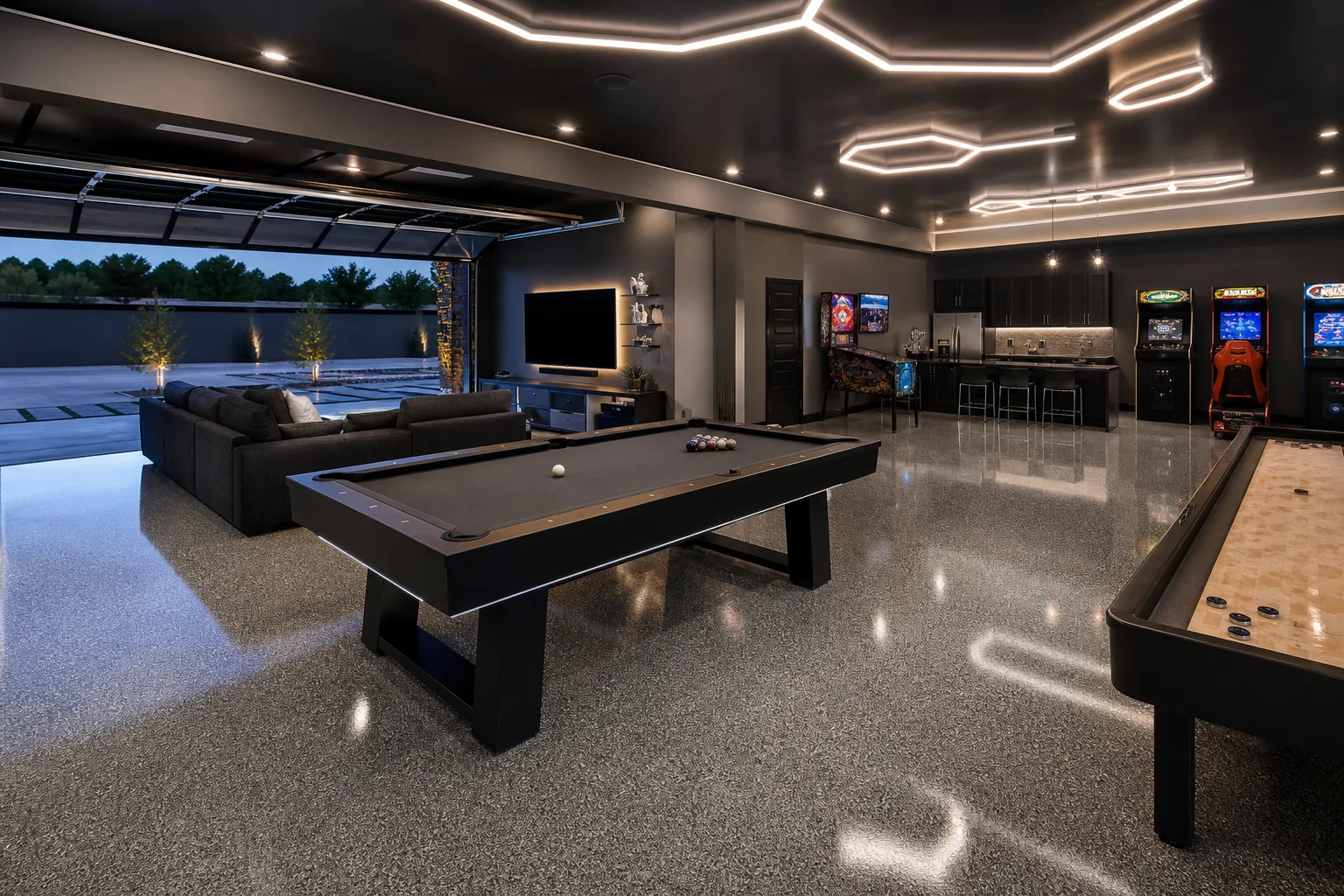
A game room scope splits into two cost buckets: conversion scope (flooring, electrical, lighting infrastructure, sometimes HVAC and structural work for garage-to-game-room conversions) and furnishing scope (equipment, lounge furniture, accessory staging, photo-prop work). The conversion cost planning guide covers the first bucket; this post covers the second. For properties with an existing dedicated game-room space (bonus room, finished basement, dedicated entertainment room), only the furnishing scope applies; for garage-to-game-room conversions, both buckets apply and the conversion bucket is usually larger than the furnishing bucket. Owners scoping game rooms should understand which bucket they are budgeting against.
Equipment tier is the largest furnishing-cost driver
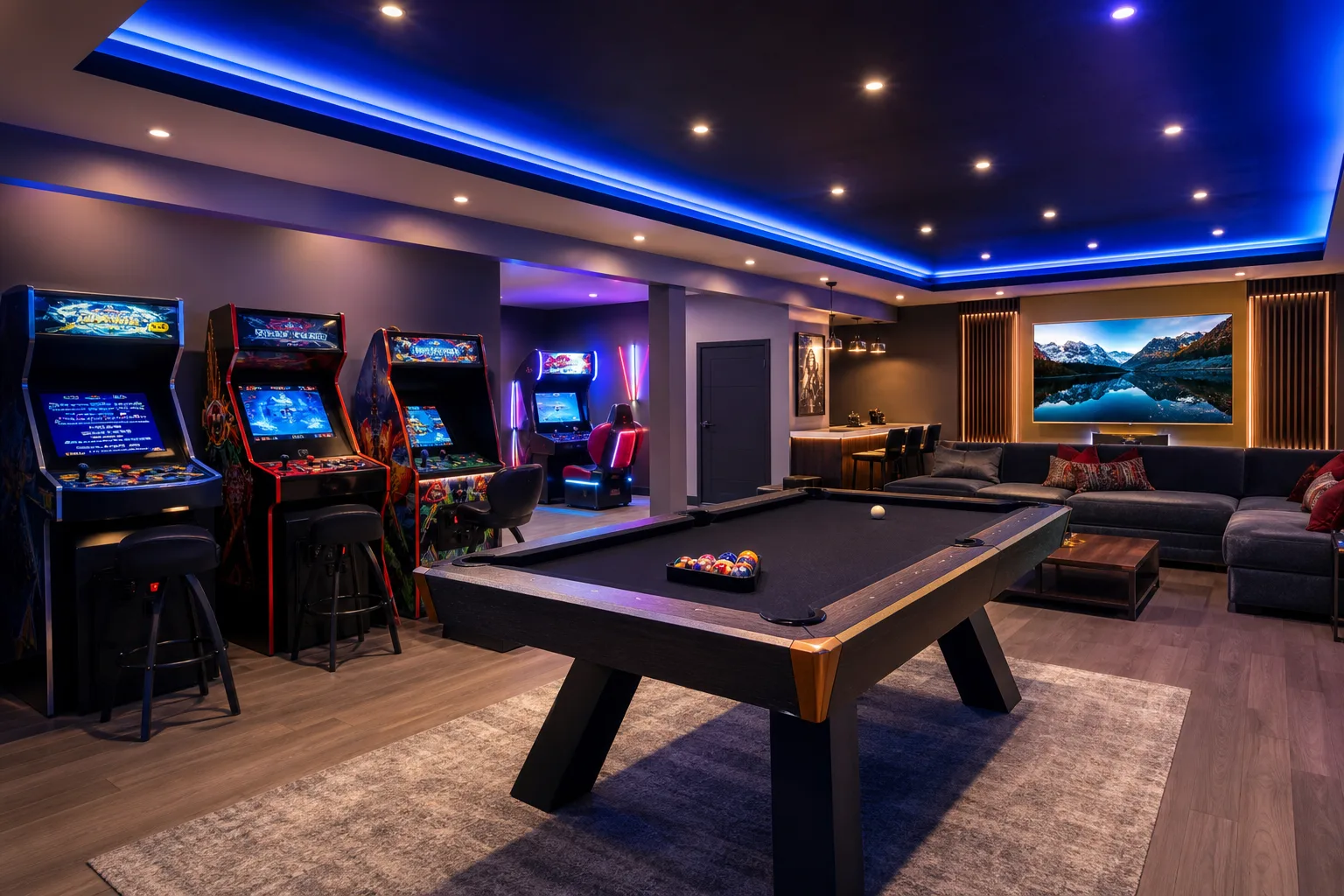
Game room equipment falls into five tiers that span a 4–5x cost range: (1) entry-tier classic arcade (refurbished cabinets, single-game machines, foosball, basic air hockey), (2) mid-tier multi-game arcade (multi-cabinet, multi-game arcade systems, regulation pool tables, mid-tier shuffleboard), (3) performance-tier equipment (commercial-grade arcade systems, regulation tournament-quality tables, integrated scoring systems), (4) luxury-tier equipment (custom-finished arcade cabinets, custom-felted pool tables, premium tournament equipment, golf simulators, racing simulators), and (5) flagship-tier equipment (full simulator rooms, multi-game integrated systems, custom-fabricated equipment, multi-room game-zone scope). The equipment-tier choice is usually the dominant driver of the furnishing scope total.
Room type changes the cost-driver mix
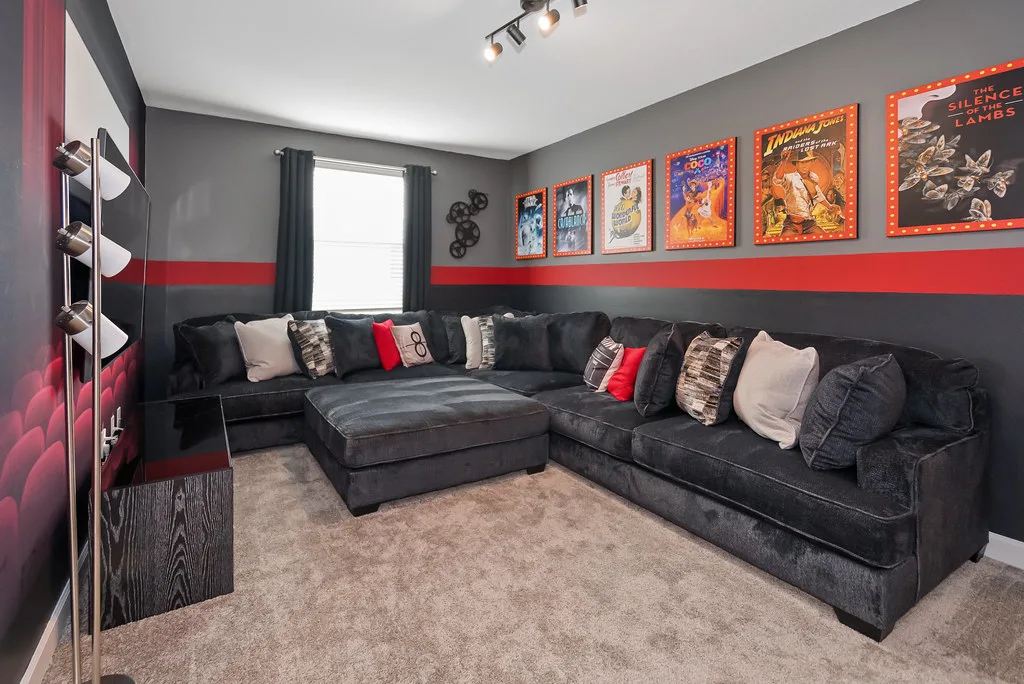
Three room-type variations have different driver mixes: arcade-only rooms (equipment is the dominant driver, lounge furniture is secondary), theater-game-hybrid rooms (theater scope adds projector, screen, theater-grade seating, acoustic treatment to the equipment scope), and multi-purpose entertainment rooms (gaming + theater + bar + lounge in a single room; equipment, finish-out, and furnishing all material drivers). Multi-purpose rooms at full amenity package and Luxury Estate scope typically run the highest furnishing totals — not because equipment is more expensive, but because four scope categories combine in a single room.
Finish-out level moves cost within equipment-tier scope
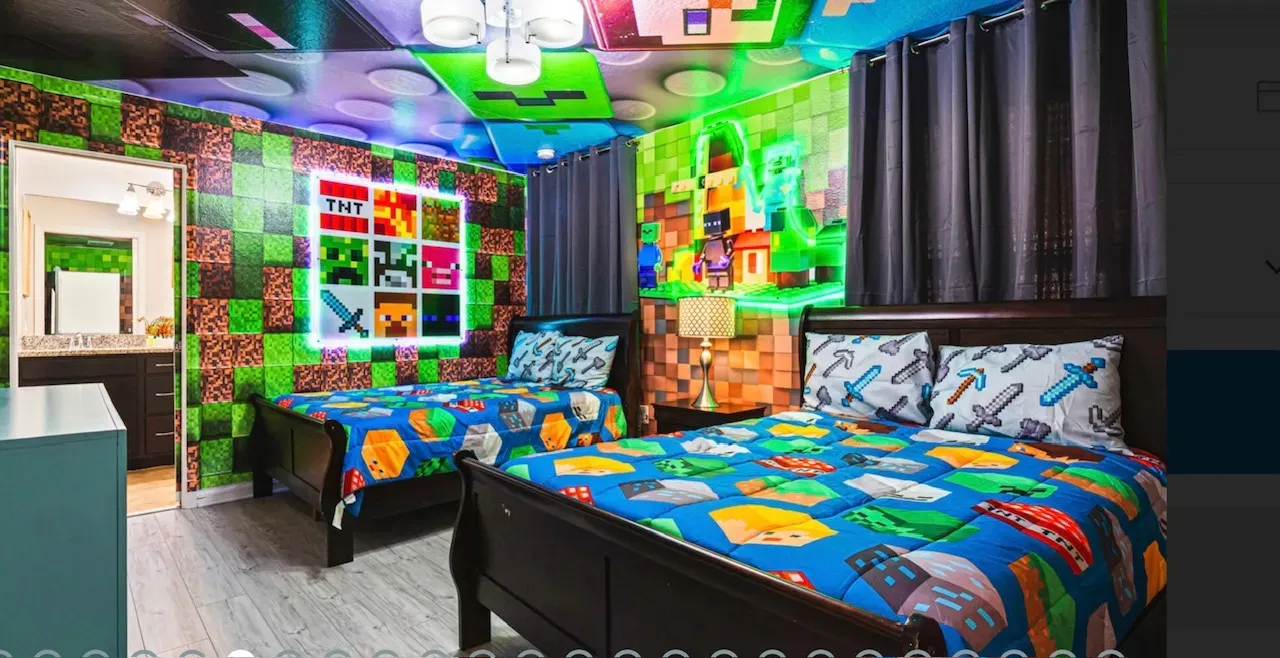
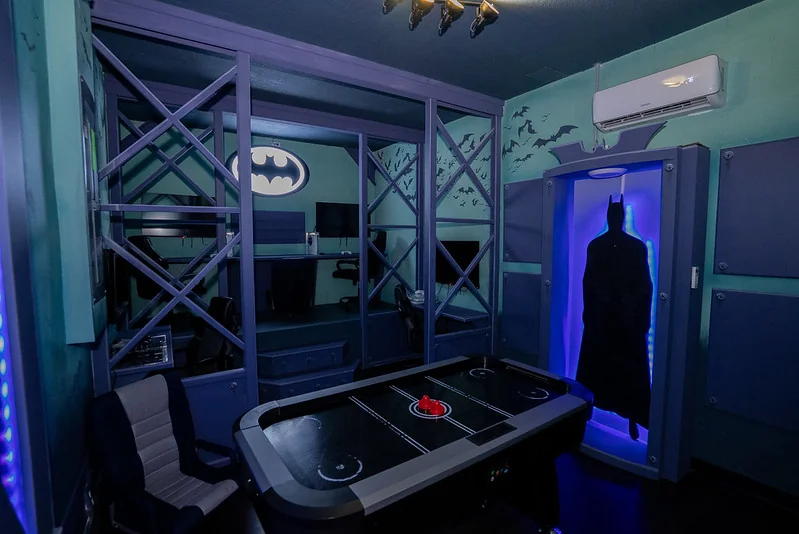
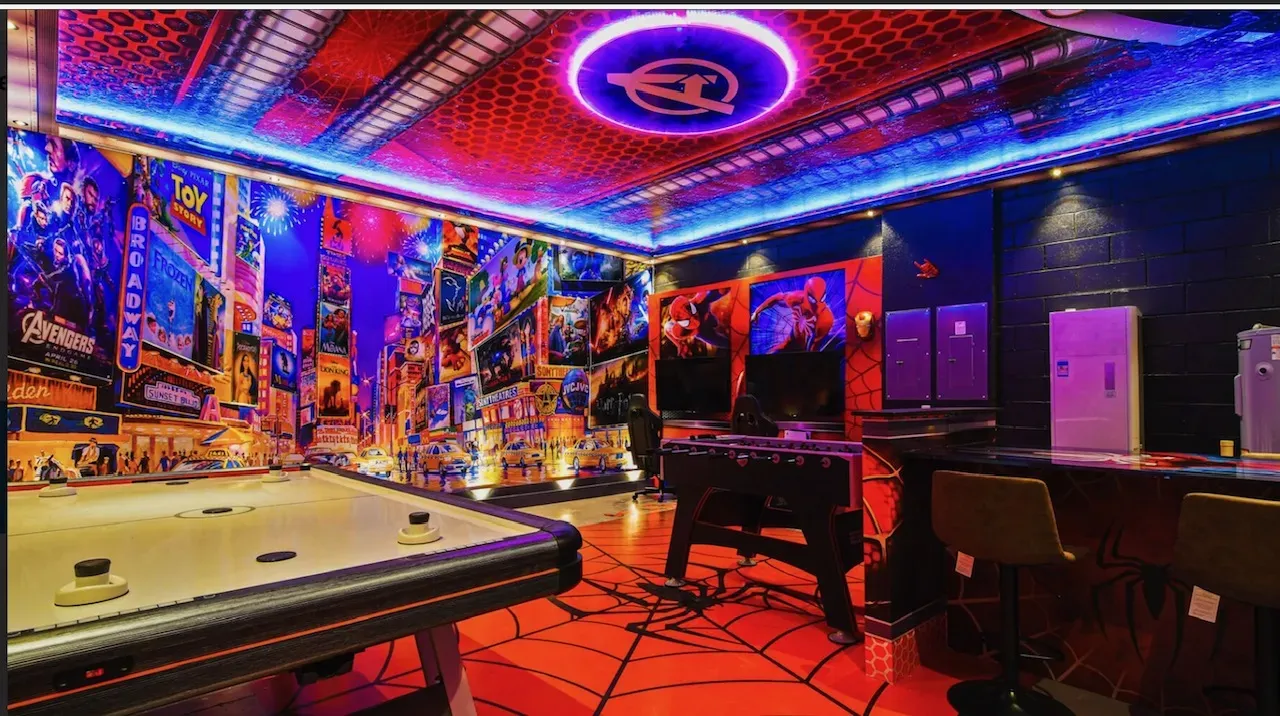
Within any equipment tier, the finish-out level moves the planning range. Standard finish-out includes performance flooring (luxury vinyl tile at STR durability spec), zone-appropriate lighting (recessed plus accent), and lounge furniture at the matching package level. Premium finish-out adds custom flooring patterns or premium LVT, integrated LED accent lighting, motion-activated zone lighting, themed wall treatments (sports-themed murals, retro-arcade neon, theater-room acoustic panels), and custom-built bar or beverage-station integration. Flagship finish-out adds full custom millwork (custom bar, custom arcade-cabinet built-ins, theme-coordinated ceiling fabrication), premium acoustics, and full smart-home integration. The same equipment-tier game room can sit at the lower or upper end of its planning range based on finish-out choices.
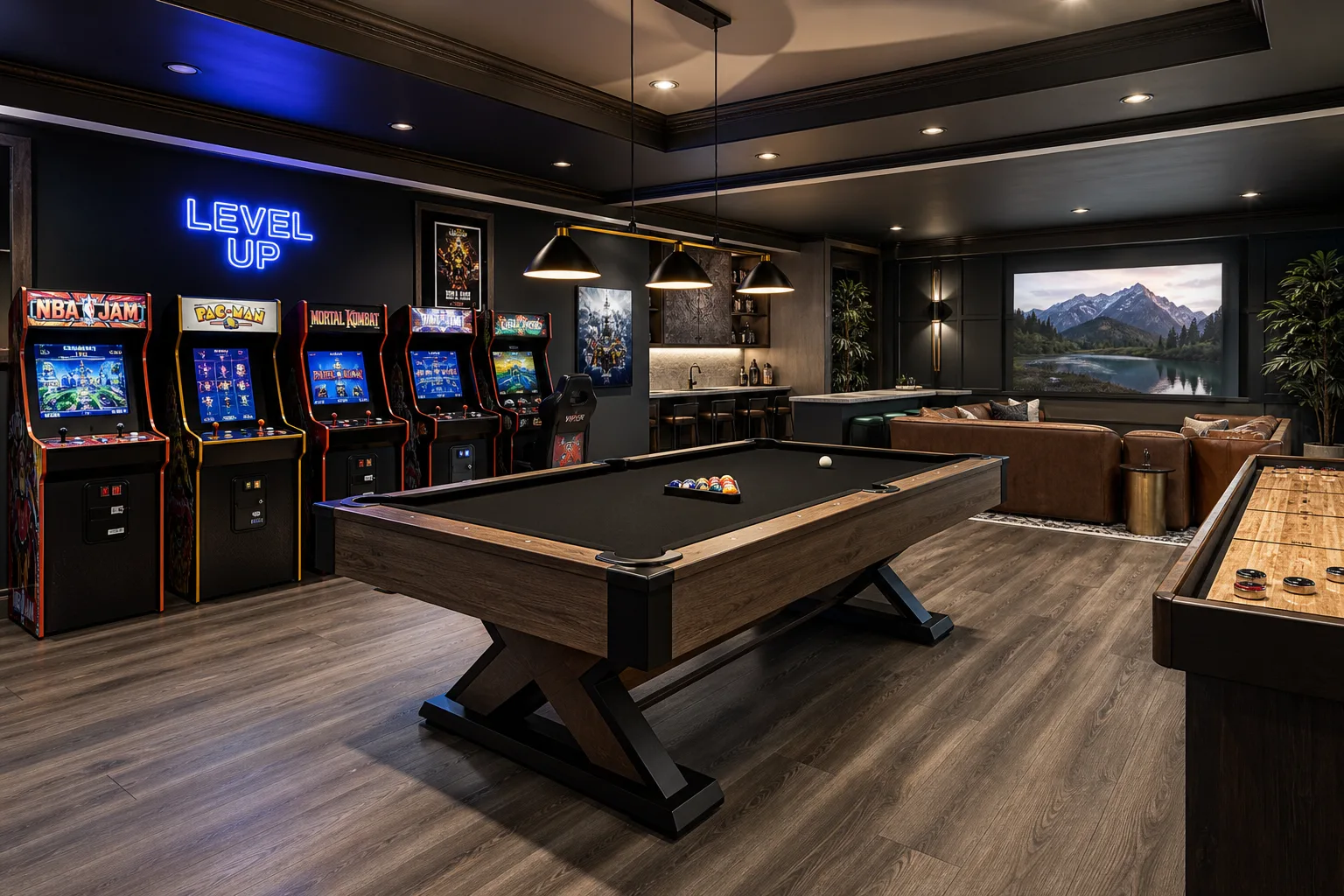
Photo-readiness is a cost line item, not an afterthought
Game rooms that photograph well in the listing listing photos have visible equipment differentiation (the arcade machines, the pool table, the simulator are visually identifiable from photographs), zone-defined lighting (the room is not flat-lit; each game zone has its own visual identity), and staged accessory work (neon signage, sports memorabilia, themed accent pieces, arcade-token wall art). Owners budgeting only for equipment and lounge furniture often end up with rooms that photograph as “a room with an arcade machine” rather than as a destination amenity. The photo-readiness scope is a real line item, not a presentation add-on. Budget roughly 8–12% of the equipment line for lighting and photo-prop work specifically — that's the range where a room crosses from photographing as storage-with-equipment to photographing as a bookable amenity. The single most common gap we see is a well-chosen pool table sitting under one flat overhead light with a bare wall behind it; move that same table under a pendant fixture with a scoreboard or neon sign on the wall, and the identical equipment reads as a finished destination room instead of an afterthought.
How bedroom count interacts with game-room cost
Game-room scope scales with bedroom count not because the room itself gets larger, but because higher-bedroom-count properties compete in higher-amenity setup guest types. A 5BR launch-ready package property with a basic arcade-only game room competes against same-bedroom-count neighbors with similar scope; an 8BR full amenity package property competes against neighbors with multi-room gaming, theater rooms, and simulator integration. The competitive-set positioning is what scales the game-room scope at higher bedroom counts — not the room itself. Mega-rental and specialty scope at 10BR+ sometimes includes multiple dedicated game zones (one classic arcade, one simulator, one theater-game-hybrid) as a single multi-room scope. As a rule of thumb, if your bedroom count puts you above the median size in your resort community, assume your game room needs to sit one tier above entry — walking three doors down to see what a competing 8-bedroom is running usually settles the question faster than any spreadsheet. Properties that skip this check tend to under-scope the room by a full tier, then wonder why occupancy trails same-size neighbors despite a lower nightly rate.
What moves the game-room planning range up
Cost drivers pushing toward the higher end of any tier: performance-tier or luxury-tier equipment selection (vs entry-tier classic arcade), multi-room or zoned scope (vs single-room arcade-only), simulator integration (golf, racing, multi-sport), custom millwork and built-in fabrication (custom bar, custom arcade-cabinet built-ins), premium acoustics and finish-out, smart-home integration, scaled photo-prop staging, and theater-room integration in hybrid scope. At Luxury Estate and Mega-Rental scope, these drivers can move the planning range 50–80% within the tier itself.
What moves the game-room planning range down
Cost drivers pulling toward the lower end: entry-tier equipment (refurbished arcade cabinets, single-game machines, foosball, basic pool table), single-room scope (vs multi-zone), standard performance flooring (vs premium LVT or custom flooring patterns), standard zone lighting (vs custom integrated LED), and assembled finish-out (vs custom millwork). A launch-ready package game room executed cleanly at the entry-tier equipment level can still photograph well in the gallery — it does not match the visual quality of a flagship-tier simulator room, but it can be the right answer for a property where game-room scope is part of the amenity setup rather than the amenity setup’s anchor.
How FPUSA scopes game rooms in proposals
Game-room scope appears as a discrete line item in our scoped proposals with explicit equipment-tier selection, room-type designation (arcade-only, theater-game-hybrid, multi-purpose entertainment), finish-out level, and photo-prop scope. For garage-to-game-room conversions, the conversion-scope line items appear separately from the furnishing-scope line items — owners can see what the conversion costs and what the furnishing costs. For full amenity package and higher package levels with multiple game zones, each zone has its own scoped line item. Owners comparing our game-room scope against alternative-vendor proposals can typically identify the equipment-tier and finish-out level differences directly.
What to do first this week
Open three same-bedroom-count comps on Airbnb or VRBO and screenshot bunk photos, outdoor dining seats, and primary suite finish. List where your home falls short — that gap list becomes your furnish scope. Send your floor plan for a scoped proposal.
What we see go wrong
- Treating game-room scope as a single line item rather than equipment + room-type + finish-out + photo-prop scope — produces proposals that obscure the dominant cost drivers.
- Confusing conversion cost and furnishing cost — conversion-scope proposals at the lower range for the conversion work get compared against furnishing-scope proposals at the upper range for the furnishing work, and the comparison is meaningless.
- Choosing entry-tier equipment in markets where the neighborhood comps runs performance-tier or higher — produces a game room that photographs as an under-scoped amenity rather than as the amenity it could have been.
- Skipping photo-readiness scope to save line items — produces rooms that photograph as “a room with an arcade machine” rather than as a destination amenity.
- Reaching for simulator scope or multi-room game zones without budgeting the multi-zone finish-out and integration scope — produces equipment installations that look like they belong in different rooms.
- Scoping game-room work without considering theater-room integration where the property already has dedicated media space — produces parallel scopes that could have been combined into a single multi-purpose entertainment room.
Related Community Guides
Eight Core Services
Turnkey to Themed Rooms — All Under One Roof
Full furniture packages, STR interior design, themed kids suites, game room conversions, property prep, custom bunks, white-glove install, and listing-ready staging — for vacation rentals and second homes across Orlando, Kissimmee, Davenport, and the full Florida STR market.
Frequently Asked Questions
How is this different from the existing game room conversion cost planning guide?
The conversion guide covers construction-adjacent scope (flooring, electrical, HVAC, sometimes structural work for garage conversions) and how the conversion process interacts with the furnishing layer. This post covers the furnishing scope itself — equipment selection, room-type variations, finish-out level, and what drives the furnishing cost up or down. The two are complementary: properties with garage conversions need both buckets; properties with existing dedicated game-room space need only the furnishing bucket. Owners scoping new game-room work should understand both.
What is the dominant cost driver inside a game-room furnishing scope?
Equipment tier. Entry-tier classic arcade, mid-tier multi-game, performance-tier, luxury-tier, and flagship-tier equipment selection spans a 4–5x cost range within the same package level. The equipment-tier choice should be the first conversation, not the last. Within an equipment tier, the next-largest drivers are room-type designation (arcade-only vs theater-game-hybrid vs multi-purpose), finish-out level, and photo-prop scope.
Should I budget for entry-tier equipment to keep cost down?
Depends on the neighborhood comps. In markets where same-bedroom-count neighbors run performance-tier or higher game-room scope (Disney-corridor resort communities at 6BR+, mega-rentals competing on amenity setup), entry-tier equipment usually does not move bookings in the way the amenity is supposed to. In markets where game-room scope is part of the amenity setup rather than its anchor, entry-tier executed cleanly with strong finish-out and photo-readiness can be the right call. The competitive-set conversation belongs at planning time, not at cost-comparison time.
Does theater-room integration always cost more than separate scopes?
Not always. For properties with limited dedicated entertainment space, integrating theater and game scope into a single multi-purpose room sometimes costs less in total than two parallel scopes — shared finish-out, shared acoustics, shared lighting infrastructure. For properties with dedicated space for both, separate scopes usually photograph better in the listing listing photos and produce a cleaner guest experience. The scope choice is property-specific and belongs at planning time.
How much of the game-room planning range goes to equipment vs finish-out vs photo-prop scope?
At entry-tier equipment, equipment is roughly 30–40% of the furnishing scope, finish-out is 40–50%, photo-prop and accessories are 10–20%. At performance-tier and above, equipment grows to 50–70% of the scope, finish-out 20–35%, photo-prop 5–15%. At flagship-tier simulator scope, equipment dominates at 70–85% of the scope. The mix is property-specific; the equipment-tier choice drives the overall shape of the breakdown.
How does this cost-driver framework apply to phased game-room scope?
Phased game-room scope (basic equipment at launch, performance-tier or flagship-tier upgrade as Phase 2) splits the cost across two install windows. Each phase has its own equipment, finish-out, and photo-prop line items. The total cost across both phases is typically 8–15% higher than a single-window install because of duplicated logistics and re-staging, but the launch-window booking revenue captured during the gap usually exceeds the differential. Phased scope is most common at full amenity package and Luxury Estate tier where the equipment-tier decision benefits from real booking data before the upgrade commitment.
What should I do first?
Pull three in-community comps with your bedroom count, note bunk, outdoor, and primary suite in the hero photos, then send your floor plan. We match package tier to that comp set before you order furniture.
I already own a pool table and a few arcade machines — can I just add furniture around what I have?
Sometimes, but check condition and finish first. A worn or mismatched pool table finish next to new performance-tier lounge furniture and fresh flooring usually looks more dated in photos than an empty room, not less. If the existing equipment is in good shape and reasonably close to your target finish tier, we build the room around it and skip that line item; if it's residential-grade or visibly worn, replacing it usually pays for itself in photo quality within the first booking cycle.