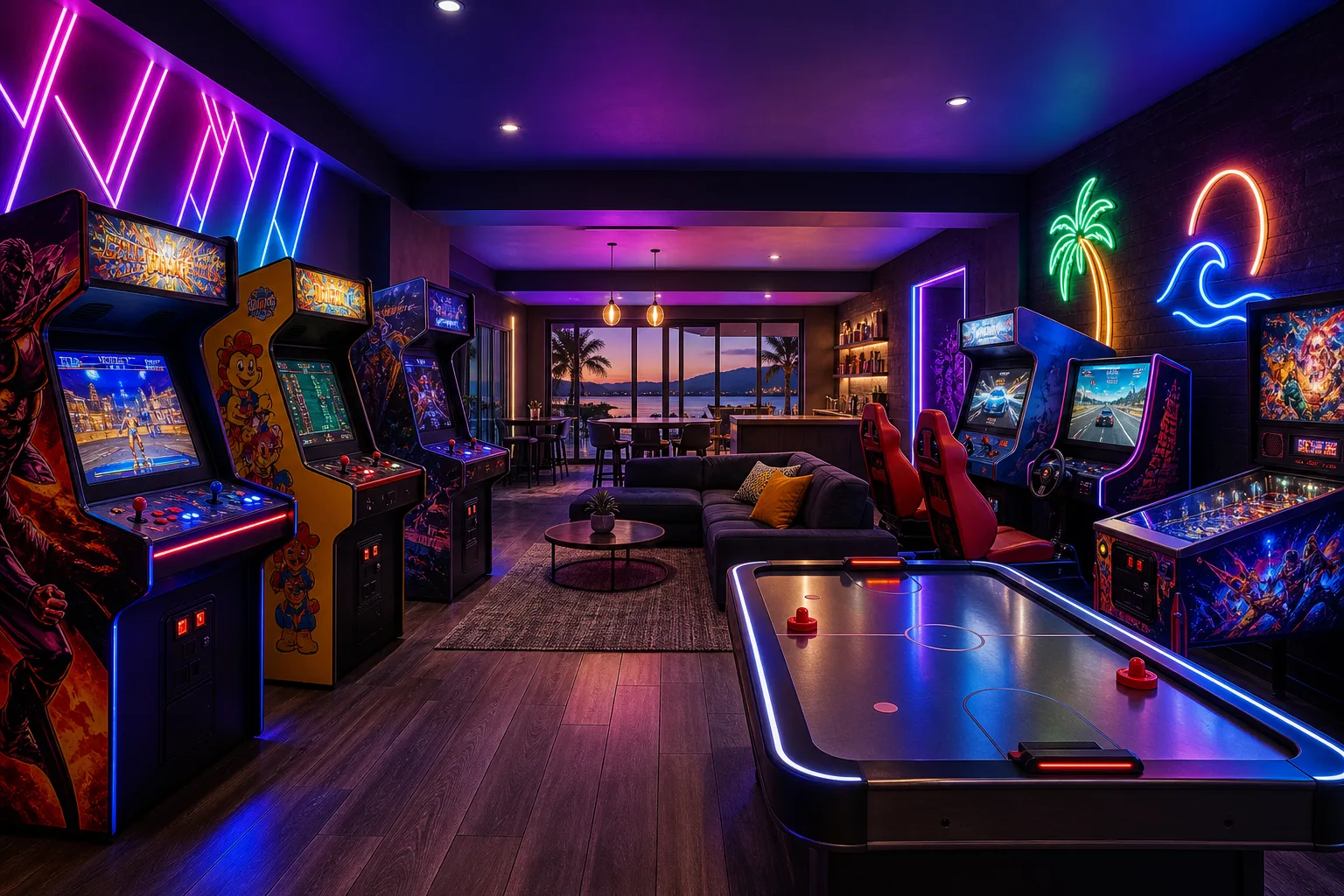
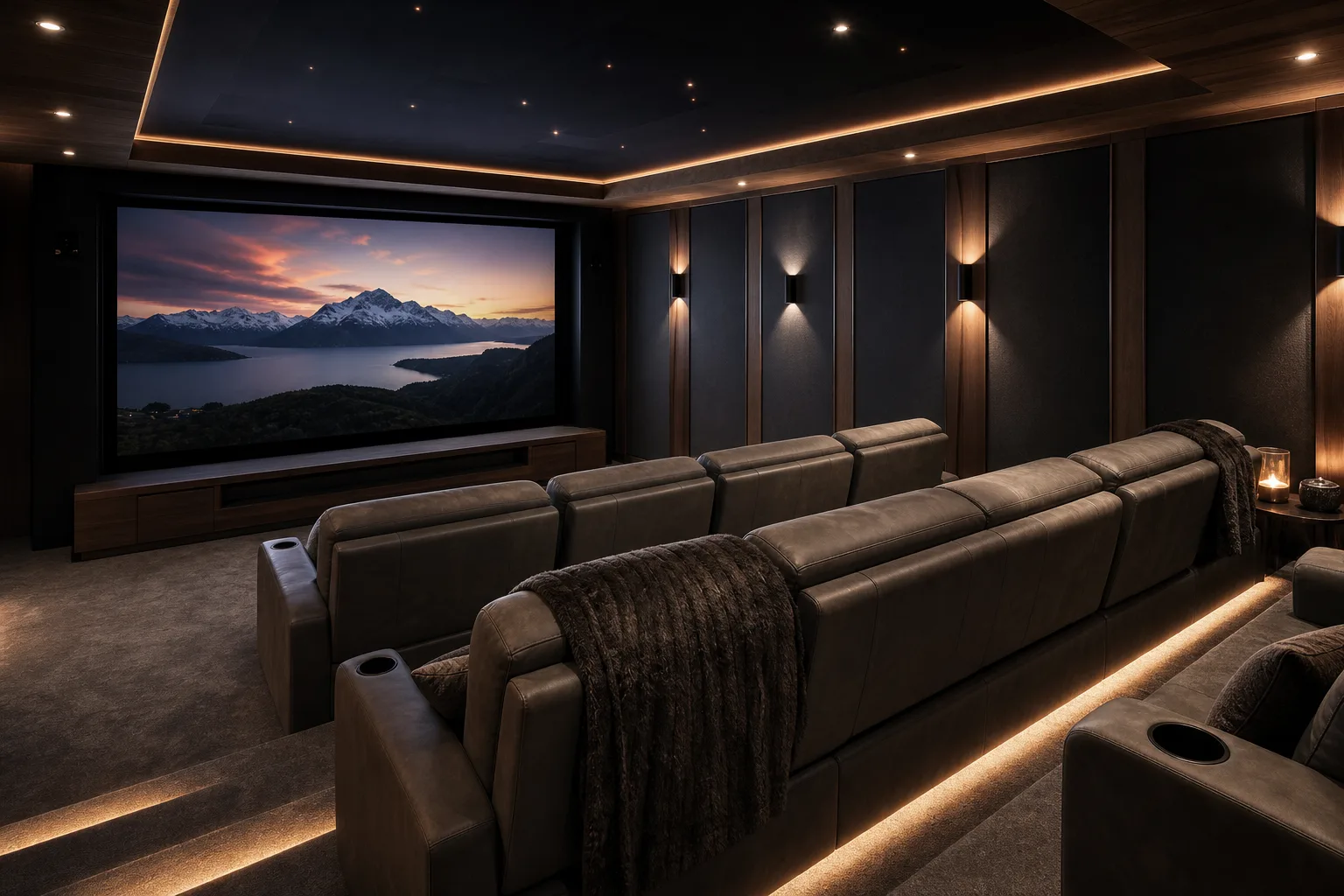
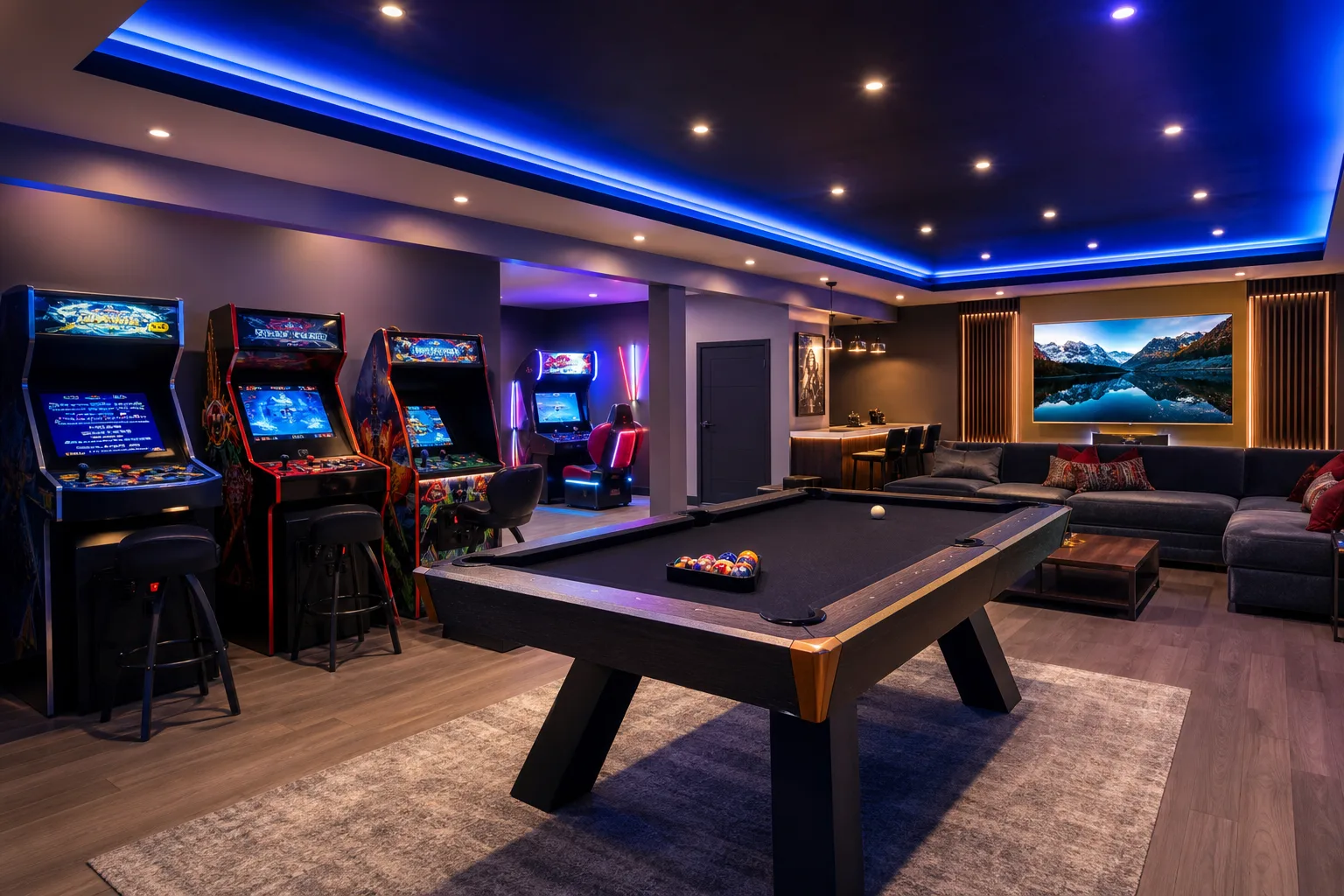
Garage to Game Room Conversion for an Airbnb
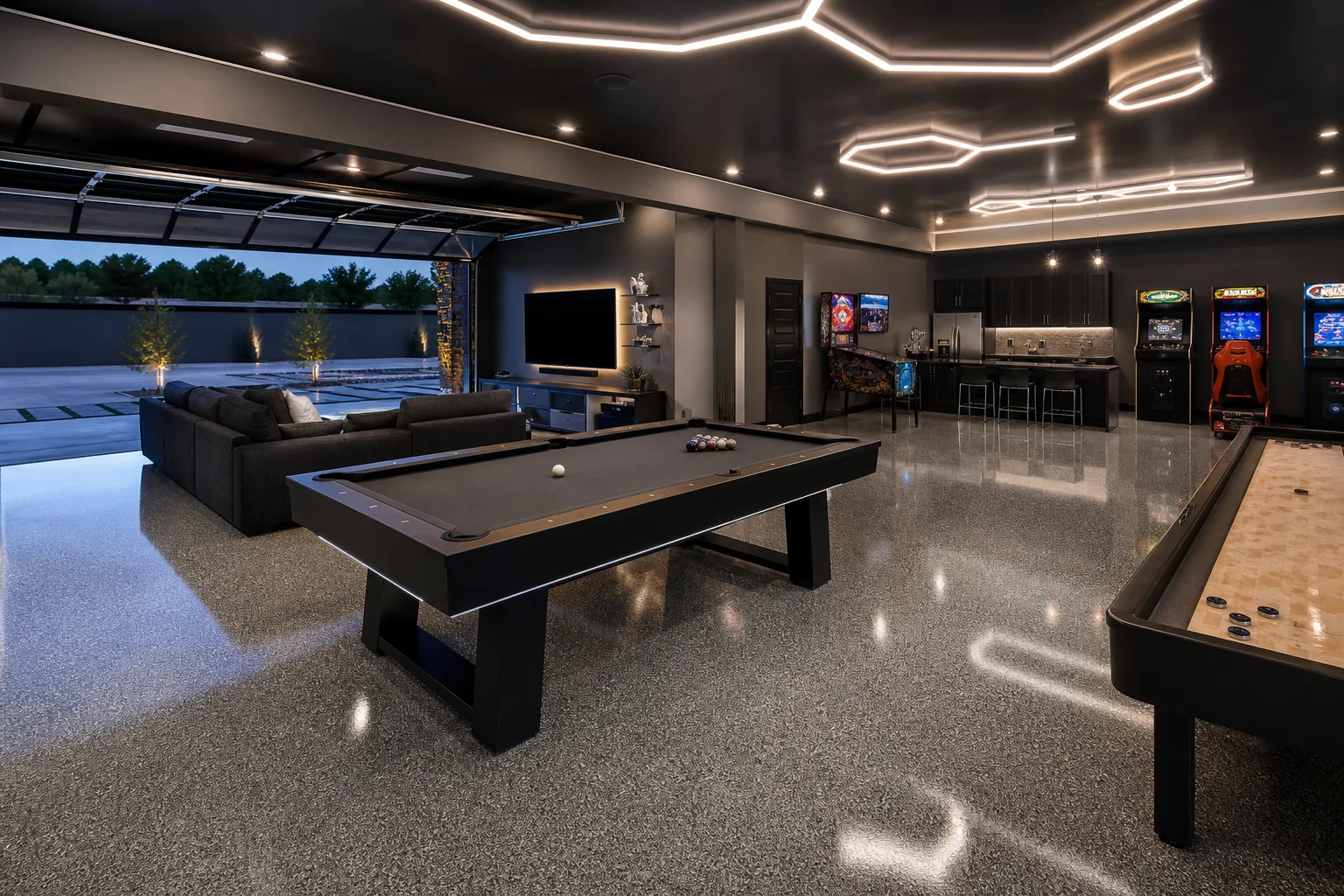
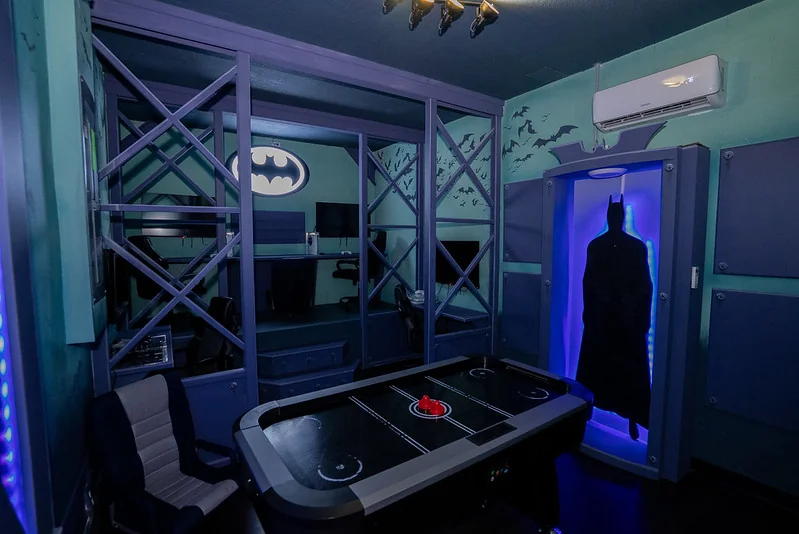
The construction execution playbook for converting a garage into an STR game room — HVAC, electrical, flooring, soundproofing, HOA, permits, and garage-door treatment. Construction-side scope, not furniture.
Sound familiar?
Most garage-to-game-room conversion content treats the project as a furniture purchase with some flooring on top. That framing misses the actual construction sequence — HVAC sizing, electrical load, flooring substrate, soundproofing, HOA approval, permit triggers, and garage-door treatment all need to land before any arcade or table game arrives on site. Owners who skip the construction-sequence planning end up with quoted budgets that double mid-project and timelines that slip into the next booking season.
In short
- Garage-to-game-room conversion is a construction-and-furnishing project, not a furniture purchase. HVAC, electrical, flooring substrate, soundproofing, HOA, and permits all sit underneath the furnishing layer and must be sequenced ahead of it.
- HOA review and permit clearance belong at the front of the project. Discovering restrictions mid-conversion is the most expensive recoverable mistake in the category.
- Central Florida garages run high humidity and heat-gain load that residential main HVAC systems usually cannot absorb. Dedicated mini-split systems sized to the room are the standard pattern; specific sizing must be confirmed by a licensed HVAC contractor.
- Typical project timeline is 8-10 weeks end-to-end across construction phases (HVAC, electrical, flooring, drywall, paint) and the furnishing-install phase that follows. Phasing furnishing simultaneously with construction produces equipment damage and listing-photo wear before the room opens.
- Construction details (HVAC sizing, electrical load, soundproofing decibel targets, permit requirements, HOA rules) are property- and jurisdiction-specific and must be verified with licensed local trades and the property’s community management before scope is committed.
- Monday action: compare your listing to three comps on bunk, outdoor, and primary suite before signing a furniture PO.
This is the construction-execution playbook for converting a garage into an STR game room — what actually happens between "we want a game room" and "the photographer arrives." The game room conversion cost planning guide covers package levels and what drives budget up or down; this guide covers the construction sequence that runs underneath every game-room project. **Construction details below describe the typical conversion scope we coordinate in the Orlando-Disney corridor; specific HVAC sizing, electrical load, permit requirements, and HOA rules vary by property, jurisdiction, and community and must be verified with a licensed local contractor before scoping committed.**
What to know
HOA and permits first
Garage conversions in resort communities almost always trigger HOA review and often require building permits. The HOA rule patterns we see in Central Florida resort communities: some communities restrict garage conversions entirely (the original garage use must be preserved); some allow conversion but require exterior to remain visually consistent (garage door must remain in place and operational); some require architectural review of any electrical or HVAC load addition; some require notification but not formal approval. Permit triggers: most jurisdictions require permits for new electrical circuits, HVAC system additions, structural changes (insulation, drywall, ceiling), and flooring substrate work. **HOA rules and permit requirements vary by community and county and must be confirmed with the property’s management association and the local building department before construction scope is committed.** Properties that skip this step and discover the restriction mid-project end up rebuilding the conversion to comply, which is the most expensive recoverable mistake in the category.
HVAC: cooling and humidity in a Florida garage
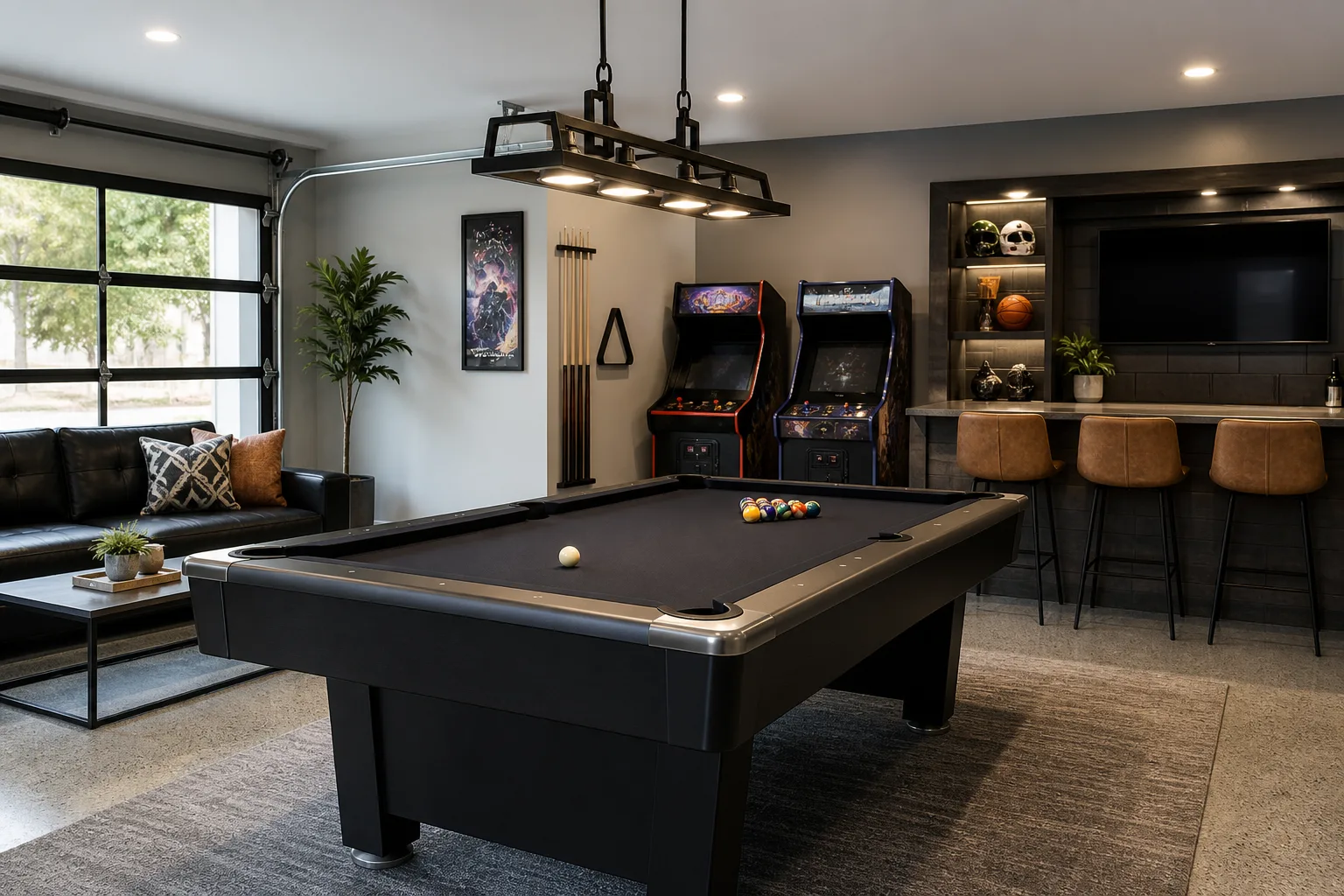
A standard residential garage in Central Florida is not climate-controlled. Converting it into a guest-occupied amenity room requires real HVAC scope: cooling capacity sized to the room volume and Florida summer heat-gain load, humidity control (Florida garage spaces typically run high humidity year-round), and integration into the main HVAC system OR a dedicated mini-split installation. **The exact HVAC sizing depends on the garage square footage, ceiling height, insulation level, window/door treatment, and the property’s primary HVAC capacity, and must be sized by a licensed HVAC contractor.** Common patterns we see: dedicated mini-split systems (single-zone or dual-zone) sized for the room rather than tying into the main system, because tying into the main system often overloads existing capacity. The HVAC work usually runs 2-4 days of contractor time and lands before flooring and drywall finishing. Photography and guest experience both depend on the room running cool and dehumidified — uncontrolled humidity will fog windows, condense on electronics, and damage arcade machine cabinets.
Electrical: dedicated circuits for arcade load
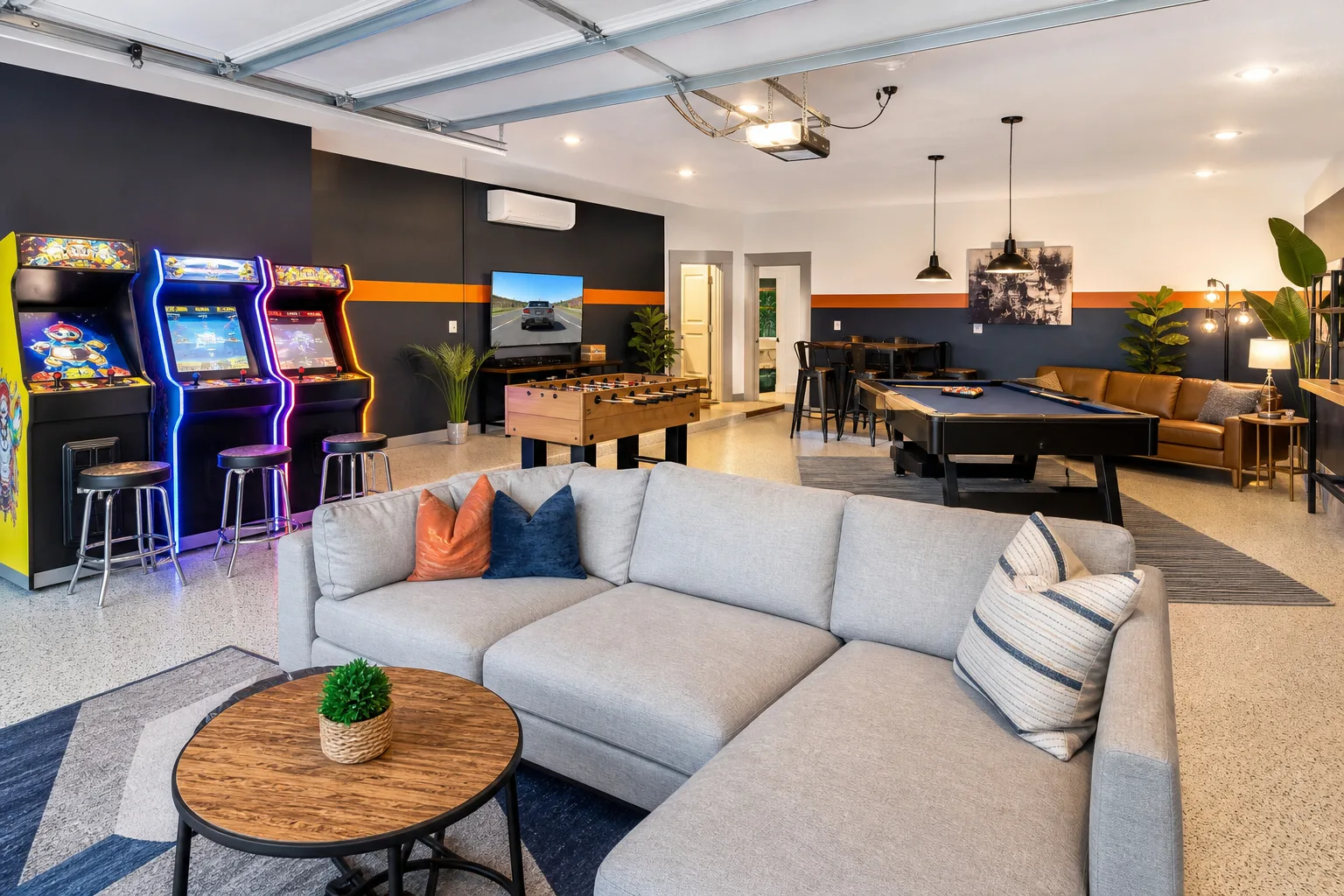
Arcade machines, table games, smart TVs, and lighting add meaningful electrical load that a residential garage circuit was not built for. Standard residential garage circuits are typically 20-amp, intended for a small set of outlets and overhead lights. A game-room conversion almost always requires additional dedicated circuits — outlet placement for each major piece of equipment, dedicated circuits for high-draw items, lighting circuits separated from outlet circuits. **The exact circuit count, amperage rating, and panel-capacity requirements depend on the equipment list, the existing panel capacity, and local building code, and must be sized by a licensed electrician.** Common patterns: arcade machines on separate circuits to avoid simultaneous-use trips, dedicated outlet placement at planned arcade locations (running cords across the floor is both unsafe and bad for photos), and ceiling-mounted lighting circuits separated for daylight + accent-light dual control. Electrical work runs 1-3 days of contractor time and lands alongside or just after HVAC.
Flooring: level the slab, then finish
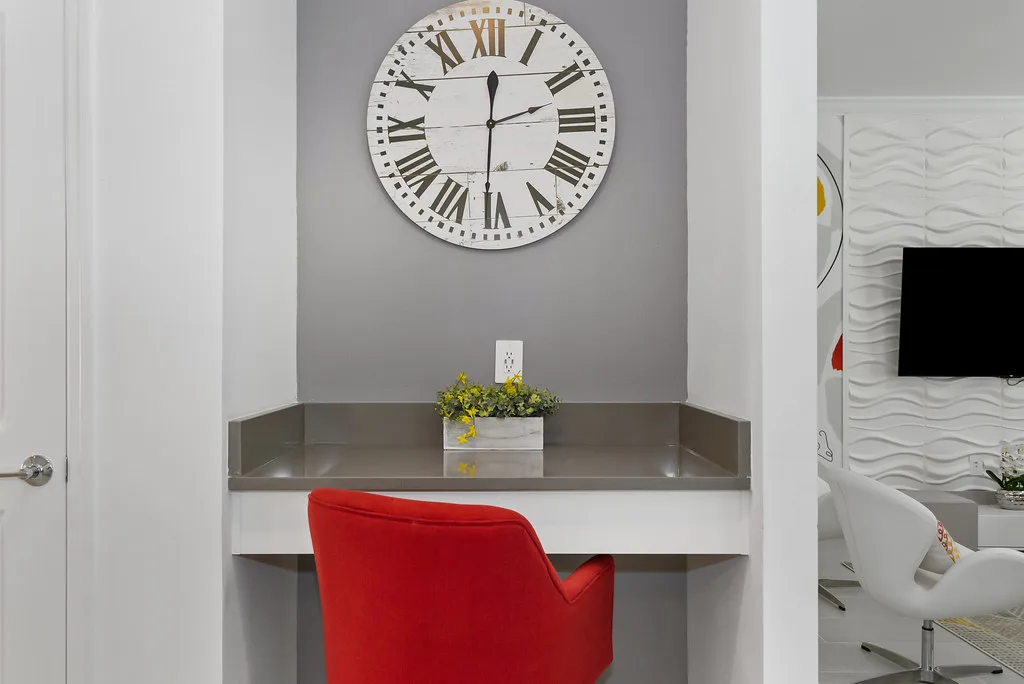
Garage floors are the construction layer that most owners under-plan. A residential garage floor is bare concrete with slope toward the garage door for drainage — neither acceptable for guest use nor flat enough for arcade and table game placement. The flooring sequence we coordinate: (1) Substrate prep — leveling compound to fill the drainage slope and any concrete cracks, moisture barrier (concrete in Florida transmits ground moisture and the flooring must be moisture-protected). (2) Insulation layer if not added during HVAC scope — game rooms photograph and feel better with floor insulation, particularly with luxury vinyl tile or engineered hardwood on top. (3) Finish flooring — luxury vinyl tile is our standard recommendation for STR game rooms (durable under wheeled arcade movement, easy to clean, photographs well under both daylight and warm lighting, scratch-resistant). Engineered hardwood is an alternative at higher package levels but requires more careful guest-use planning. Avoid: carpet (snags arcade machine feet, photographs dingy in 6 months), polished concrete (cold and industrial in listing photos), residential laminate (the substrate transfer is visible). Flooring work runs 3-5 days of contractor time after substrate prep cures.
Soundproofing: bedrooms above the garage
Game rooms produce sound that adjacent bedrooms hear. Arcade machine attract-mode chimes, pool ball clatter, foosball spinner clack, and TV audio all carry through standard residential wall construction. Soundproofing scope we coordinate: (1) Wall treatment between the game room and adjacent bedrooms — sound-dampening insulation (mineral wool or equivalent) added inside the wall cavity during the drywall phase, sometimes paired with a second drywall layer for higher attenuation. (2) Ceiling treatment if there’s an occupied room above the converted garage — sound-dampening between joists. (3) Door treatment — solid-core doors with weatherstripping seal at the threshold, replacing standard hollow-core garage-passage doors. **Decibel-reduction outcomes vary by construction quality and the specific wall-cavity treatment; specific sound-attenuation targets should be discussed with the construction contractor and measured against the property’s adjacent-bedroom layout.** Soundproofing failure shows up in listing reviews ("could hear arcades from upstairs bedroom"), which is the most common review-cycle damage from a poorly-planned game-room conversion.
Garage door: most HOAs want it to stay
Most Central Florida HOAs require the garage door to remain in place and operational even after the garage is converted to an interior amenity room. The interior treatment options: (1) Insulated finish on the inside face of the garage door (matching the room’s wall finish — drywall sometimes possible but movement and weight constraints apply; otherwise rigid foam insulation panels with decorative finish). (2) Permanent interior partition wall built inside the garage door, with the door operable behind it (some HOAs require the door to remain operable; the partition wall makes the room feel finished without violating the requirement). (3) For HOAs that allow it, full door removal and infill wall — rarely permitted in resort communities. **The exterior-preservation requirement is community-specific and must be confirmed with the HOA before garage-door treatment is committed.** This is the single most-overlooked construction detail in DIY garage conversions and the source of most HOA citations against converted game rooms.
Phase build before furniture arrives
Garage-to-game-room conversion runs on a phased construction-then-furnishing timeline that requires sequencing across multiple trades. Typical phasing we coordinate: (1) Week 1-2: HOA review confirmed, permits filed, HVAC contractor scheduled. (2) Week 3-4: HVAC installation, electrical rough-in. (3) Week 5-6: Substrate prep, insulation, drywall, ceiling finish. (4) Week 7: Flooring install. (5) Week 8: Paint, baseboard, electrical fixture install, HVAC trim. (6) Week 9: Furnishing layer install — arcade machines, table games, lounge seating, accessory layer, smart TV. (7) Week 10: Photography. **Actual project timelines vary by contractor availability, permit-review cadence, HOA-review cadence, and equipment lead times; the sequence above is illustrative and must be confirmed against the specific contractor schedule.** Properties that try to install furnishing simultaneously with construction end up with arcade machines covered in drywall dust or relocated repeatedly during install — both produce visible wear in listing photos before the property opens.
How we coordinate build and furnish
We start with HOA and permits, line up HVAC and electrical with local trades, finish construction, then install arcade, tables, and lounge seating — furniture never sits in a dusty garage during drywall. You get one proposal with construction and furnish as separate line items plus a week-by-week plan. Final price is always property-specific.
What to do first this week
Open three same-bedroom-count comps on Airbnb or VRBO and screenshot bunk photos, outdoor dining seats, and primary suite finish. List where your home falls short — that gap list becomes your furnish scope. Garage to game room? Send community and dimensions — we'll separate HVAC and build scope from furniture.
What we see go wrong
- Quoting the conversion as furniture-only scope — misses HVAC, electrical, flooring substrate, soundproofing, and HOA-treatment work that always sits underneath.
- Skipping HOA review at the front of the project — discovering restrictions mid-conversion forces rebuild work and is the most expensive recoverable mistake in the category.
- Tying the new HVAC load into the main system without sizing capacity — overloads the property’s primary HVAC and produces complaints from guests in adjacent bedrooms.
- Treating residential garage outlets as adequate for arcade and TV load — circuits trip during peak guest use and the listing accumulates "the games kept stopping" reviews.
- Installing finish flooring without leveling the drainage slope or moisture barrier — flooring buckles within months in Florida humidity.
- Skipping soundproofing between the game room and adjacent bedrooms — sound carries through standard wall construction and becomes a review-cycle complaint.
- Removing the garage door without HOA approval — community citation risk that almost always forces partial rebuild.
- Installing arcade machines and table games before the construction phase is fully complete — drywall dust and trade movement damage equipment before the room opens.
Related Community Guides
Eight Core Services
Turnkey to Themed Rooms — All Under One Roof
Full furniture packages, STR interior design, themed kids suites, game room conversions, property prep, custom bunks, white-glove install, and listing-ready staging — for vacation rentals and second homes across Orlando, Kissimmee, Davenport, and the full Florida STR market.
Frequently Asked Questions
How long does a garage-to-game-room conversion actually take?
Typical project timelines we coordinate run 8-10 weeks end-to-end (HOA/permit review, HVAC, electrical, flooring, drywall, paint, furnishing install, photography). Faster timelines are sometimes possible when HOA approval is pre-cleared and contractor availability lines up, but compressing below 6 weeks usually skips phases that show up as problems later (flooring under-cured, HVAC commissioning incomplete, soundproofing inadequate). **Project-specific timelines depend on the contractor schedule, permit-review cadence, and HOA-review cadence, and must be confirmed in the scoped proposal.**
Do garage conversions in Central Florida resort communities require permits?
In most cases yes — electrical work (new circuits, panel additions), HVAC work (new systems or significant load additions), and structural changes (insulation, drywall, ceiling) typically require building permits in Osceola, Polk, Lake, and Orange counties. **Specific permit requirements vary by jurisdiction and the exact work scope and must be confirmed with the local building department before construction starts.** HOA approval is a separate process from county permitting and is required in most resort communities. Both processes should be cleared at the front of the project to avoid mid-construction surprises.
Can I keep the garage door operational and still convert the space?
Yes — and most HOAs require it. The interior treatment options are insulated finish on the inside face of the door (rigid foam panels with decorative finish is the most common pattern), or a permanent interior partition wall built inside the operational garage door. The door stays functional from the exterior; the interior of the converted room looks finished without violating the exterior-preservation requirement. The exact treatment depends on the HOA rule wording and must be confirmed with the community management.
How does the game-room HVAC tie into the main property HVAC?
In most cases we recommend a dedicated mini-split system sized for the converted room rather than extending the main HVAC system. Garage conversions in Central Florida typically run high heat-gain load (radiant heat through the garage door, ground heat through concrete, summer solar load) that residential main HVAC systems were not sized to handle as additional zones. **Specific HVAC sizing and the tie-in vs dedicated-system decision must be confirmed by a licensed HVAC contractor against the property’s existing system capacity and the converted room’s heat-gain calculation.** Trying to tie a new room into an under-capacity main system usually produces complaints from guests in other rooms when the system runs constantly.
What about converting a den or bonus room instead of a garage — same process?
Den and bonus-room conversions are simpler because the space is already climate-controlled, the flooring substrate is usually finished, and the room is part of the conditioned envelope. The construction scope drops to electrical adjustments (additional outlets, dedicated circuits for high-draw equipment), soundproofing between the den and adjacent bedrooms, lighting work, and minor finish updates. No HVAC scope, no garage-door treatment, no substrate work. Den conversions typically run 2-4 weeks vs 8-10 weeks for garage conversions, and the cost differential is meaningful. The game room conversion cost planning guide covers the den-vs-garage scope decision.
What should I do first?
Pull three in-community comps with your bedroom count, note bunk, outdoor, and primary suite in the hero photos, then send your floor plan. We match package tier to that comp set before you order furniture.
How much does a full garage-to-game-room conversion typically cost, including construction?
Because the construction scope — HVAC, electrical, flooring, soundproofing — is property-specific and depends on garage size, existing HVAC capacity, and local contractor rates, there isn't a single number that covers the combined construction-plus-furnish project accurately. As a planning reference, the furnishing layer alone (arcade, table games, lounge seating) typically falls within the published game-room package ranges on the amenity service page; construction adds to that total and is quoted separately by the licensed contractor handling HVAC, electrical, and flooring.