Pool Deck Furniture Sized to Sleep Count
Your pool is the hero photo — but four loungers for fourteen guests sends everyone inside. Here's how we spec deck furniture to match sleep count.
Sound familiar?
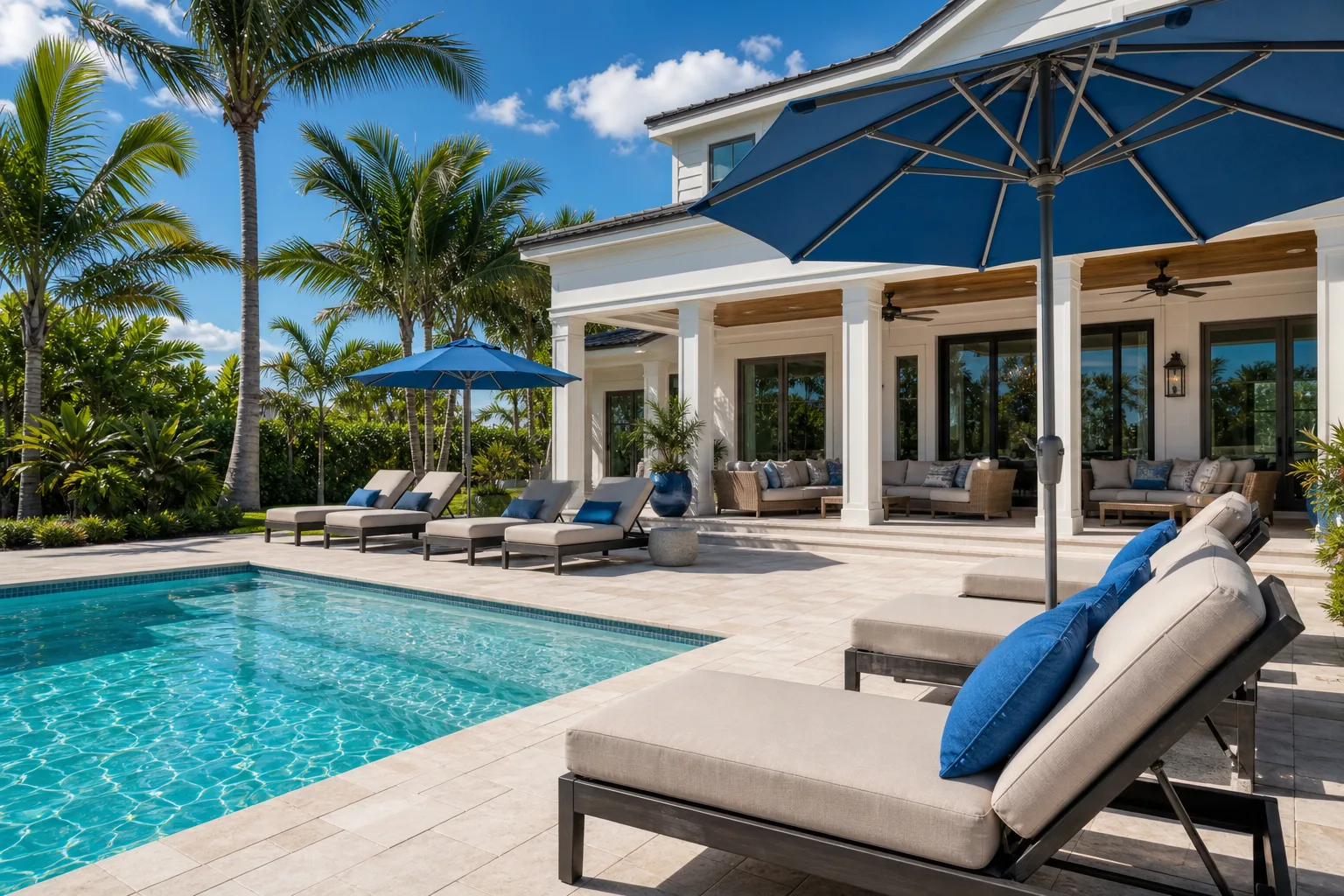
You spent on the pool but staged the lanai with four chaises for a home that sleeps fourteen. Guests eat inside all week, mention it in reviews, and your hero photo loses to neighbors with full lounger rows and outdoor dining for the whole group.
In short
- Pool area furniture is a listing photos decision — the pool shot is usually in slot 1 or 2 of the gallery and the furniture composition drives the first-amenity impression. Budget priority should match the gallery-position priority.
- Lounger count should approximate sleep count divided by 1.5 — 4 loungers at 4BR-5BR launch-ready package; 6 at 6BR-7BR full amenity package; 8-10 at 8BR Luxury Estate; 10-14 at Mega-Rental / Specialty scope.
- Material discipline matters — commercial-grade aluminum or resin wicker with Sunbrella fabric is STR-grade; residential big-box furniture fails within a single Florida summer. The lifetime cost is similar; the listing photos stability is meaningfully different.
- Shade is operational infrastructure, not an accessory. Umbrellas at lower package levels; permanent shade structures (pergola, attached patio cover) standard at 7BR-8BR full amenity package and above. Permanent structures may require permits and must be verified against Florida Building Code.
- Side tables, planters, and accent staging separate "fully-furnished" from "luxury-staged" in the gallery. The staging layer is small line items individually but compounding in photo impact. Hurricane protocol and pool-barrier requirements are operational scope that protects the investment and must be verified with HOA and local building authority.
- Monday action: compare your listing to three comps on bunk, outdoor, and primary suite before signing a furniture PO.
This is the furniture-piece companion to our outdoor entertainment guide. The outdoor guide covers lanai, fire pit, and hurricane prep; this one goes deep on pool deck furniture — lounger count, dining size, shade, side tables, and the layout that makes your second hero photo work. **Outdoor-electrical, pool-barrier, and screen-enclosure rules vary by county and HOA — verify with local trades before you order.**
What to know
Size loungers and dining to sleep count first
Three reasons the pool deck earns budget priority. (1) Photo slot — most Central Florida STR listings lead with an exterior pool shot in slot 1 or 2. Under-furnished decks shrink click-through to interior shots. (2) Booking weight — family and group travelers filter on pool quality; strong deck photos sustain conversion against same-floor-plan neighbors. (3) Replacement math — residential big-box sets fade and break within a Florida summer; commercial-grade loungers and Sunbrella fabric hold photo quality for years. Lifetime cost is similar; photo stability is not.
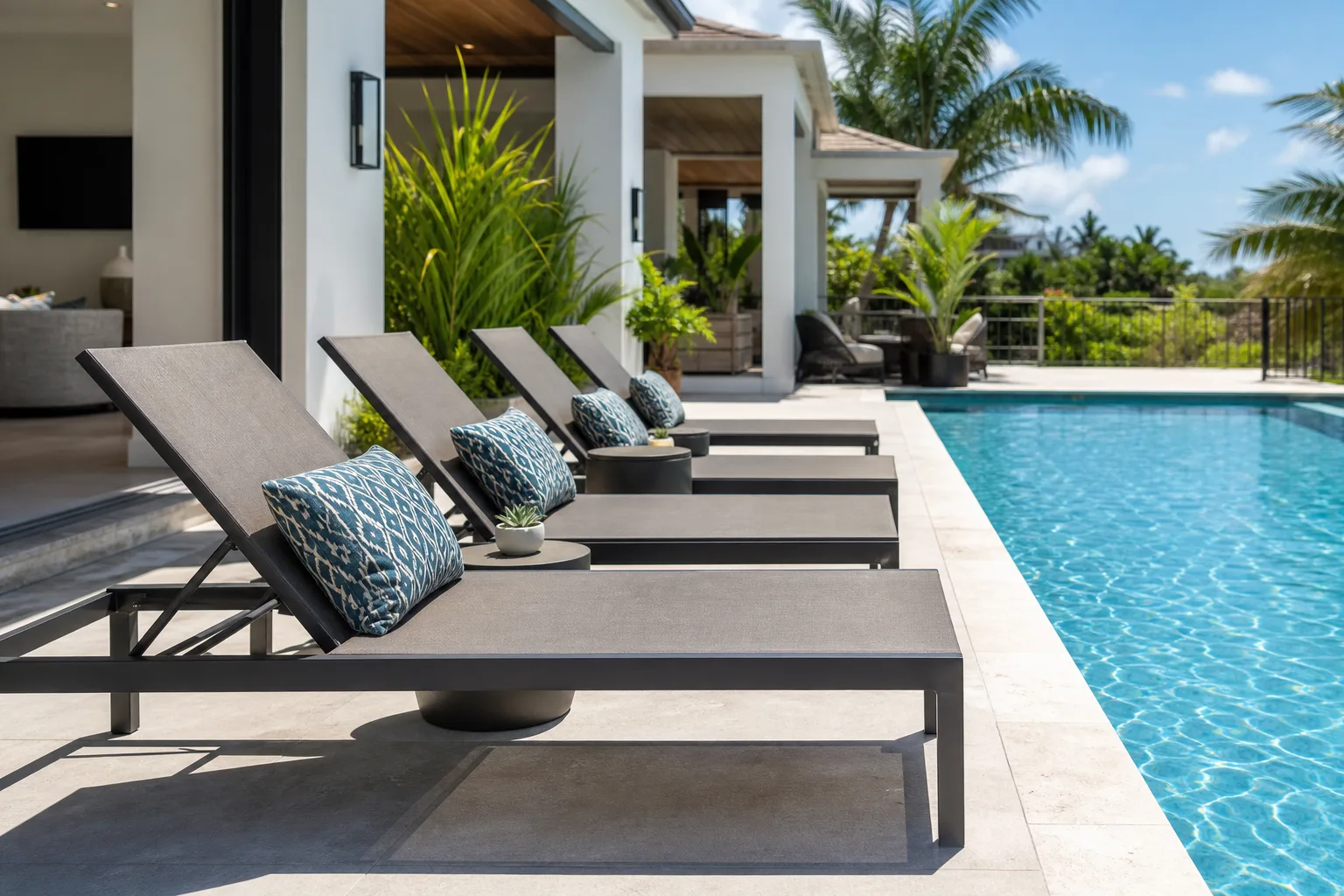
Lounger count: roughly sleep count divided by 1.5
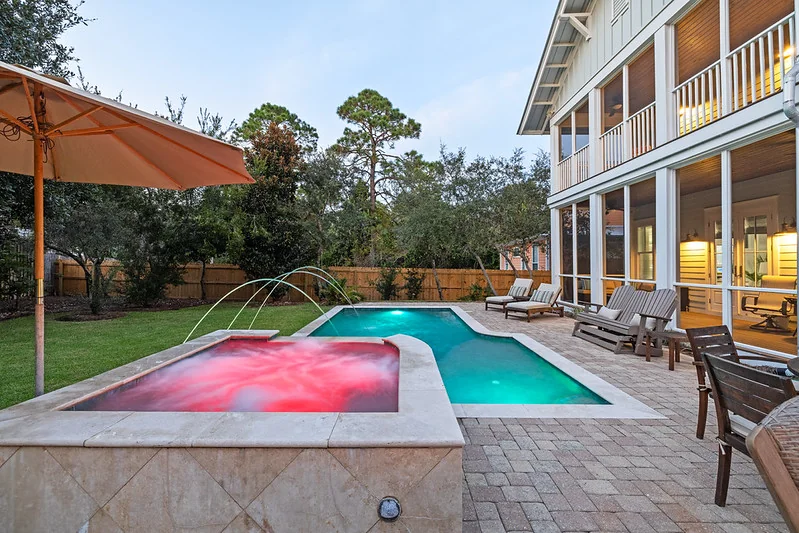
The lounger row is the strongest single furniture composition on the pool deck. Spec and layout discipline: (1) Lounger count by bedroom — 4 loungers minimum at 4BR-5BR launch-ready package; 6 loungers at 6BR-7BR full amenity package; 8-10 loungers at 8BR+ Luxury Estate scope; 10-14 loungers at Mega-Rental / Specialty scope. Loungers should approximate the sleep count divided by 1.5 (some guests will use the dining set or lanai sectional concurrently, but the lounger row should accommodate roughly two-thirds of guests simultaneously). (2) Lounger material — commercial-grade aluminum frame with quick-dry sling or commercial-grade resin wicker with Sunbrella cushion. The two materials photograph differently — sling reads as modern and minimal, wicker-and-cushion reads as resort-luxe. Higher package levels usually favor the wicker-and-cushion composition. (3) Layout pattern — loungers positioned along the long axis of the pool, facing the sun direction or facing the lanai opening (depending on the property orientation). Avoid: scattered lounger placement, loungers facing away from the pool, loungers too close to the pool edge (creates safety concern and limits walking clearance). The lounger row should read as an intentional composition, not as overflow seating. (4) Lounger height and styling — adjustable backrest loungers (5-position or stepless recline), styled with a folded pool towel or styled throw pillow on the foot of each lounger for the photo. Empty unstyled loungers read as "installation-day" rather than "guest-ready."
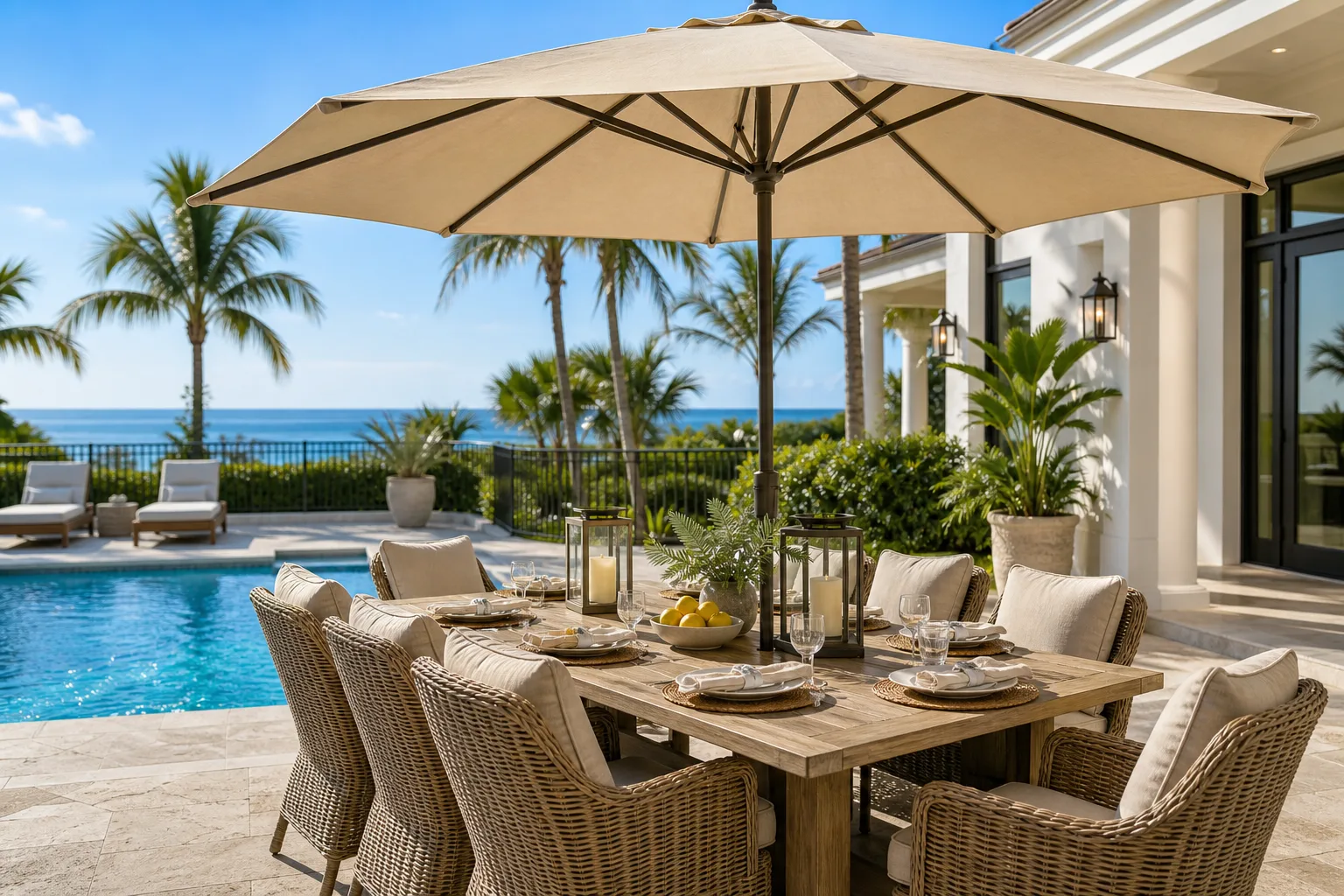
Outdoor dining must seat the full group
The pool-side dining set is the second-strongest pool deck composition but is routinely under-scoped. Spec discipline: (1) Table sizing by bedroom — 8-seat dining at 5BR-6BR full amenity package; 10-12 seat dining at 7BR-8BR Luxury Estate; sometimes split across two tables or expanded to 12-14 seats at Mega-Rental scope. The dining set should accommodate the property’s rated sleep count for outdoor meals — guests want to dine together at the pool deck, and undersized tables produce visible "they could not all sit together" composition issues. (2) Table material — commercial-grade aluminum or teak base with weather-resistant tabletop (HPL high-pressure laminate, tempered glass, or sealed teak). Avoid: residential glass tabletops (break under accidental impact; safety hazard with kids around the pool), residential plastic tabletops (warp in Florida UV). (3) Chair selection — armchair-style outdoor dining chairs with Sunbrella seat cushions (back cushions optional, often skipped to reduce hurricane-storage labor), or commercial-grade resin wicker armchairs at higher package levels. Avoid: bench seating (limits dining-group flexibility for varied guest groups), residential plastic chairs (snap under guest weight). (4) Shade integration — large center umbrella with weighted base, or permanent shade structure (pergola, attached patio cover) at higher package levels. Pool-side dining without shade is unusable during Florida midday — properties without it accumulate "they had no shade" review complaints. (5) Layout — dining set positioned 8-10 feet from the pool edge to provide walking clearance; not in the direct path between pool and lanai (creates traffic friction during meal sessions).
Umbrellas, shade structures, and the Florida-sun calculation
Shade is not optional on a Central Florida pool deck — it is operational infrastructure. Three package levels. (1) Center pool umbrella + dining umbrella — large center cantilever umbrella (10-13 foot diameter) over a portion of the lounger row plus a center-pole umbrella over the dining set. Standard at 4BR-6BR launch-ready package and full amenity package. (2) Multiple umbrellas + permanent shade element — 2-3 umbrellas across the deck plus a permanent pergola or attached patio cover over part of the deck. Standard at 7BR-8BR full amenity package where the deck size supports the additional shade footprint. (3) Permanent shade structures — pergola over the dining set, attached patio cover extending the lanai roof, retractable awning systems. Standard at 8BR+ Luxury Estate and Mega-Rental scope. Spec for umbrellas: Sunbrella or equivalent solution-dyed acrylic fabric (residential umbrella fabric fades within one Florida summer), commercial-grade aluminum or fiberglass rib construction (residential umbrellas snap in moderate wind), heavy weighted base (50-75 lb base minimum; lighter bases tip in wind and become safety concerns). Hurricane storage: umbrellas come down in tropical storm and hurricane watch conditions — the hurricane protocol covered in the outdoor entertainment guide applies. **Permanent shade structures (pergola, attached patio cover) require verification against Florida Building Code for the specific jurisdiction and may require permits; specific structural requirements must be verified with a licensed contractor.**
Side tables, accent pieces, and the staging layer
Side tables and accent pieces transform the pool deck from "loungers + dining set" into a staged amenity composition. The standard staging layer: (1) Side tables between loungers — small outdoor side table between every pair of loungers, supports beverage and accessory staging during guest use. Material matches the lounger frame (aluminum or resin wicker). Skipping side tables produces the "guests holding drinks awkwardly" composition issue that depresses the lounger-row photo. (2) Larger end tables at the lounger row ends — slightly larger end table at the start and end of the lounger row, supports planter or styled accent piece. (3) Outdoor planters — pool-deck-appropriate planters (resin or fiberglass; ceramic chips and breaks under accidental impact, glazed terracotta sometimes works at higher package levels) with UV-tolerant plants (palms, succulents, ornamental grasses). The planters anchor the pool deck composition with vertical green that softens the all-furniture composition. (4) Pool-deck accent decor — outdoor lanterns or candles for evening composition (LED battery-operated for safety; no open flame near pool deck for liability), styled outdoor accent pieces (sculptural element, oversized terracotta accent vessel). The accent layer is what separates "fully-furnished pool deck" from "luxury-staged pool deck" in the gallery. (5) Towel storage and pool accessory bin — discreet outdoor towel storage cabinet or styled basket near the pool entry; pool accessory bin (pool noodles, beach balls, pool floats) staged but not chaotic. The towel-storage detail signals operational care to bookers who recognize the staging level.
Towel storage, pool accessories, and the small-details layer
The small-details layer separates pool decks that look professionally-staged from pool decks that look "we put furniture out." (1) Towel storage — discreet outdoor towel cabinet (powder-coated steel or marine-grade plywood) near the pool entry, with sufficient towel inventory for the rated sleep count plus 2-4 spares. Towels rolled and stacked visibly during turnover, not crammed inside the cabinet. The towel composition is a small but visible detail in the pool-deck wide shot. (2) Pool accessory inventory — pool noodles (color-coordinated to the pool deck palette; avoid mismatched random colors), beach balls, pool floats (curated set, not chaotic dollar-store bin), pool safety equipment (life ring, reaching pole — required at most resort communities and an operational reminder for the cleaning crew to verify present each turnover). (3) Outdoor pool-deck shower — most Central Florida pool decks include an outdoor shower for rinsing before pool entry. Outdoor shower hardware should be in functioning condition and styled with a wall-mounted soap holder and styling shelf. (4) Outdoor speakers — Bluetooth outdoor speakers or permanent outdoor audio (covered in the broader outdoor entertainment guide). The speakers add an listing amenity appeal at higher package levels but the operational complexity (guest pairing, theft concerns at lower package levels, weather durability) should be planned in advance. (5) Trash and recycling staging — outdoor weather-resistant trash receptacles, positioned discreetly out of the primary photo composition but accessible to guests during pool deck use. **Pool barrier requirements (fence height, gate self-close, alarm where applicable) vary by Florida building code and community and must be verified with the property’s HOA and the local building authority.**
Hero photo prep: golden hour, calm water, staged towels
Pool deck photography has specific composition rules that differ from indoor amenity photography. (1) Sun-direction — best pool deck shots happen at golden hour (the hour after sunrise or before sunset) when the sun is low and warm. Midday sun produces harsh shadows on the deck surface and washes out the pool color. Photographers should be briefed on the sun-direction relative to the deck orientation before the shoot date. (2) Camera angle — wide-angle lens from a low position at the pool edge or from the lanai opening, capturing the lounger row, pool, and dining set in the same composition. The shot from the upper-floor balcony looking down on the pool deck is a useful secondary shot but should not be the primary; ground-level composition reads as guest-perspective. (3) Pool surface — pool water should be clean, calm, and reflective during the shoot. Cleaning crew should run the pool 24-48 hours before the shoot to clear debris and stabilize the chlorine; pool pump should be off during the actual photo capture to produce calm reflective water (then turned back on after). (4) Staged scene — loungers staged with rolled towels at the foot of each lounger, styled cushions or throw on one or two loungers, dining set with table runner and styled centerpiece (outdoor-rated, no glass), umbrella partially deployed for shade composition, pool accessories visible but curated. (5) Photo timing relative to landscaping — pool deck shots should happen after landscaping refresh (palm fronds trimmed, planters refreshed, grass edges clean). The themed-room photo strategy guide covers the photographer briefing principles that apply to pool-deck photography with outdoor-specific adjustments.
How FPUSA scopes pool area furniture
Our pool deck furniture consultation walks through (a) deck dimensions and layout drawing — lounger row length, dining set placement, shade-structure footprint, walking clearance, (b) sun direction and shade requirement — where the umbrellas and permanent shade structures need to land to absorb the Florida midday sun, (c) package tier composition — launch-ready package vs full amenity package vs Luxury Estate vs Mega-Rental composition with appropriate furniture count and material grade, (d) staging layer — side tables, planters, accent decor, towel storage, pool accessories, (e) photography prep — staging plan for the gallery-leading pool deck photo, sun-direction timing for the shoot, pool prep cadence in the days before the shoot, (f) hurricane and operational protocol — storage location for cushions and umbrellas, tie-down hardware for heavier furniture, cleaning protocol between turnovers. The output is a scoped proposal that line-items the lounger spec, dining set spec, umbrella spec, side tables, accent layer, towel storage, and pool accessories — with a layout drawing for the deck and the staging plan for the photo. Published planning ranges for outdoor scope sit on the relevant service pages. Final pricing depends on material grade, count, and deck size; the outdoor entertainment guide covers the broader amenity setup pricing context, and the 8-bedroom vacation rental cost guide explains how outdoor scope interacts with bedroom-count math.
What to do first this week
Open three same-bedroom-count comps on Airbnb or VRBO and screenshot bunk photos, outdoor dining seats, and primary suite finish. List where your home falls short — that gap list becomes your furnish scope. Pool deck is your hero photo? Send dimensions — we'll spec loungers, dining, and staging for the shoot.
What we see go wrong
- Residential-grade big-box pool loungers and dining sets — fade, break, and stain within a single Florida summer. The listing photos cycles through visibly-different deck compositions every 12-18 months.
- Undersized lounger count for the bedroom count — 4 loungers at an 8BR property reads as under-furnished against same-floor-plan neighbors with proper lounger rows.
- Skipping shade — Florida midday sun makes unshaded pool decks unusable for several hours and produces review complaints about heat exposure.
- Residential umbrella fabric (non-Sunbrella) — fades within one Florida summer and the gallery deteriorates as the umbrella color shifts.
- Glass dining tabletop on the pool deck — breaks under accidental impact and is a safety hazard with kids around the pool. Use HPL, tempered glass, or sealed teak instead.
- No side tables between loungers — produces the "guests holding drinks awkwardly" composition issue. The cost differential is small; the photo impact is meaningful.
- Pool deck shot at midday sun rather than golden hour — harsh shadows, washed-out pool color, weaker gallery impact. Photographer briefing should specify shot timing.
- No hurricane storage protocol for cushions and umbrellas — inventory disappears in every active hurricane season and outdoor scope gets rebuilt repeatedly.
Related Community Guides
Eight Core Services
Turnkey to Themed Rooms — All Under One Roof
Full furniture packages, STR interior design, themed kids suites, game room conversions, property prep, custom bunks, white-glove install, and listing-ready staging — for vacation rentals and second homes across Orlando, Kissimmee, Davenport, and the full Florida STR market.
Frequently Asked Questions
How many pool loungers does my vacation rental need?
Approximately the sleep count divided by 1.5. For a 5BR property sleeping 12, that means 8 loungers (typical 6BR-7BR full amenity package); for an 8BR property sleeping 18, that means 10-12 loungers (typical Luxury Estate scope). The math assumes some guests will use the dining set or lanai sectional concurrently rather than every guest on a lounger simultaneously, but the lounger row should accommodate roughly two-thirds of guests at the same time. Undersized lounger counts read as "under-furnished" in the gallery and produce review complaints.
What is the right material for pool loungers in Florida vacation rental use?
Two patterns work: commercial-grade aluminum frame with quick-dry sling (modern, minimal aesthetic, lightweight for hurricane storage, easiest to clean), or commercial-grade resin wicker with Sunbrella cushion (resort-luxe aesthetic, slightly heavier for storage, requires cushion management). Both materials photograph well in the gallery; the choice usually comes down to property positioning and package level. Residential-grade aluminum loungers from consumer-retail channels bend under guest weight; residential plastic loungers yellow in Florida UV and crack within months. Both are non-starters for STR use.
Do I need permanent shade structures or are umbrellas enough?
Umbrellas are sufficient at 4BR-6BR launch-ready package and full amenity package. Permanent shade structures (pergola, attached patio cover, retractable awning) become standard at 7BR-8BR full amenity package where the deck size supports the additional footprint and the amenity setup positioning expects permanent shade infrastructure. At 8BR+ Luxury Estate and Mega-Rental scope, permanent shade structures are part of the standard composition. **Permanent shade structures may require permits and must be verified against Florida Building Code for the specific jurisdiction.** Umbrellas alone at 8BR scope read as under-furnished in the gallery.
How does the pool deck furniture scope interact with the rest of the outdoor amenity layer?
The pool deck furniture scope is one component of the broader outdoor amenity layer — pool deck staging, lanai sectional, fire pit zone, outdoor TV scope, outdoor lighting, hurricane planning. The pool deck furniture is usually the largest single line item in the outdoor budget and produces the leading gallery photo; the lanai sectional is usually the second-largest line item and produces the strongest covered-outdoor composition. The outdoor entertainment space guide covers the broader amenity strategy; this guide covers the pool deck furniture specifically.
When does the pool deck need a photo refresh?
Properties with commercial-grade pool furniture typically refresh the gallery pool deck photo every 3-5 years, alongside larger property photo refresh cycles. Properties with residential-grade pool furniture often need to refresh every 12-18 months because the inventory deteriorates visibly. The refresh decision depends on whether the underlying furniture inventory still photographs cleanly; if the umbrella fabric has faded, the lounger sling has stretched, or the dining set looks weathered, the new photos look the same. Refresh the inventory first, then refresh the photo.
What should I do first?
Pull three in-community comps with your bedroom count, note bunk, outdoor, and primary suite in the hero photos, then send your floor plan. We match package tier to that comp set before you order furniture.
What does it typically cost to refresh just the pool deck furniture without touching the rest of the property?
A pool-deck-only refresh is one of the more affordable single-amenity upgrades since it skips indoor furniture, bedding, and install labor entirely — cost scales mainly with lounger count, dining set size, and whether you're adding a permanent shade structure. Most owners can turn around a full deck refresh (loungers, dining, umbrellas, staging layer) inside 2-3 weeks since it's off-the-shelf outdoor furniture rather than custom fabrication. Final cost depends on material grade and deck size, confirmed through a scoped proposal.
Related Reading
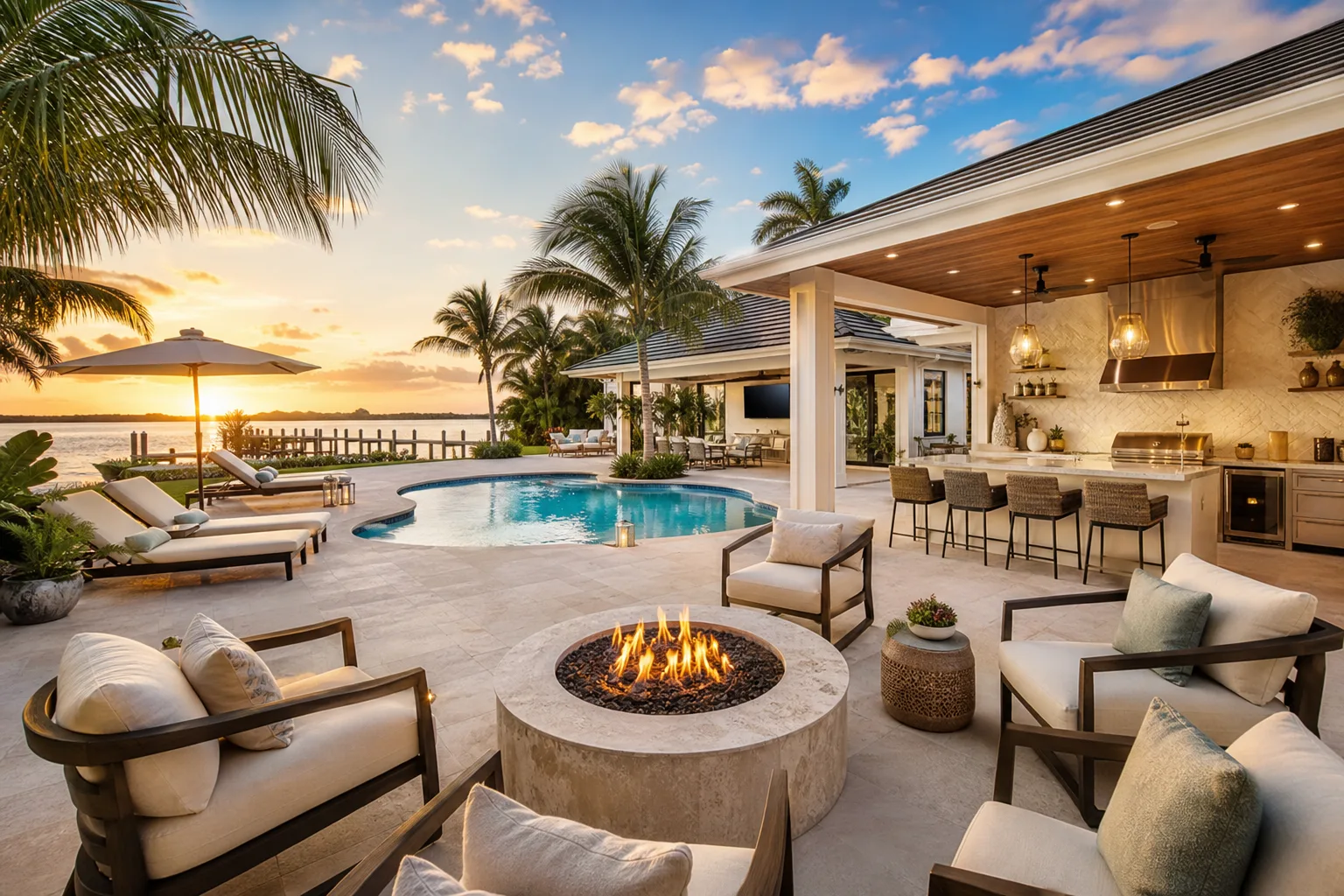
Outdoor Entertainment Space for an Airbnb (Pool Deck, Lanai, and the Amenity Layer Most Owners Underbuild)
Cost to Furnish an 8-Bedroom Vacation Rental (And Why It is a Different Business Than 5BR)